
Part 5: International Courts that deal with human rights cases
I. The International Court of Justice
resource: http://www.icj-cij.org/homepage/index.php?p1=0
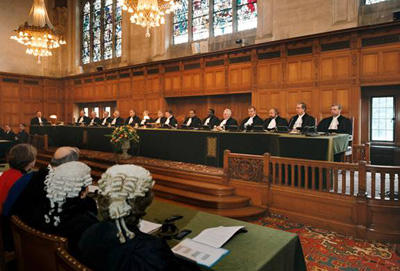
The International Court of Justice (ICJ) is the principal judicial organ of the United Nations (UN). It was established in June 1945 by the Charter of the United Nations and began work in April 1946.The seat of the Court is at the Peace Palace in The Hague (Netherlands). Of the six principal organs of the United Nations, it is the only one not located in New York (United States of America). The Court’s role is to settle, in accordance with international law, legal disputes submitted to it by States and to give advisory opinions on legal questions referred to it by authorized United Nations organs and specialized agencies. The Court is composed of 15 judges, who are elected for terms of office of nine years by the United Nations General Assembly and the Security Council. It is assisted by a Registry, its administrative organ. Its official languages are English and French.
II. The European Court of Human Rights
The European Court of Human Rights was founded in 1998 by the Council of Europe to streamline enforcement and judicial functions of the European Commission of Human Rights (http://en.wikipedia.org/wiki/European_Court_of_Human_Rights). Its earlier incarnations grew out of the formation of the Council of Europe (http://www.coe.int/)
in1950, which adopted its “Convention for the Protection of Human Rights and Fundamental Freedoms” as a code of honor for its signatories, now numbering 47 countries. The court oversees all cases related to human rights and freedoms in its jurisdictions and hears appeals arising from them. All member states have agreed to abide by the principals of the Convention for Human Rights, which include the following:
Article 1 – an obligation to respect human rights
Article 2 – the right to life
Article 3 – the prohibition of torture
Article 4 – the prohibition of slavery
Article 5 – the right to liberty and security
Article 6 – the right to a fair trial
Article 7 – no punishment without law
Article 8 – the right to privacy
Article 9 – the right to freedom of thought, conscience, and religion
Article 10 – the right to freedom of expression
Article 11 – the right to freedom of assembly and association
Article 12 – the right to marry
Article 13 – the right to an effective remedy
Article 14 – the prohibition of discrimination
For additional articles and protocols, see http://en.wikipedia.org/wiki/European_Convention_on_Human_Rights.
III. International Criminal Court (not recognized by the U.S.)
The U.S. opposed the establishment of the ICC in 1998 in Rome. Over 160 nations sent delegations, including the United States. When the terms of organization were completed, 102 nations became signatories of the treaty. The U.S., China, Iraq, and Libya were among those nations refusing to sign. The deliberations were barely covered by U.S. media outlets. North Carolina Senator Jesse Helms, then chairman of the Senate Foreign Relations Committee, wrote a letter to Secretary of State Madeleine Albright, insisting that unless the U.S. had veto power of the court’s decisions, it should be considered “dead on arrival” when it came to the Senate for ratification. The Clinton administration insisted that the U.N. Security Council approve every investigation into allegations of “crimes against humanity.” Opposition to the court hardened under the Bush government, ostensibly to protect U.S. military and political leaders from being held accountable to uniform global standards of justice and prosecution for war crimes. The court was formally installed in The Hague, Netherlands, in 2002 to investigate and prosecute large-scale crimes against humanity, such as genocide.
Official court website: http://www.icc-cpi.int/about.html
For more about U.S. opposition, go to: www.globalpolicy.org/ intljustice/icc/index.htm See also L.A. Times Op-ed article below, March 29, 2005:
IV. U.S. Obstructs Global Justice by Jonathan F. Fanton
When a United Nations commission of inquiry recommended this year that gross human rights abuses in Darfur be referred to the new International Criminal Court, Pierre-Richard Prosper, the U.S. ambassador at large for war crimes issues, made headlines by rejecting the idea. "We don't want to be party to legitimizing the ICC," he said. But why not? Ninety-eight nations have signed the Rome Treaty, which created the court that the United States now opposes. President Clinton signed the treaty too, in the final days of his term, but the Bush administration quickly said it had no intention of seeking ratification.
The ICC, which is already up and running in The Hague, has jurisdiction over crimes of genocide, crimes against humanity and war crimes committed after July 1, 2002, if and when the justice system of a signatory country is unwilling or unable to act. What's going on in Darfur seems exactly suited for the court, but the U.S. has said it would rather pursue those who have committed atrocities in Darfur by creating a separate court in Arusha, Tanzania — even though such ad hoc tribunals are slow to organize and costly to run. "We don't want to be in a situation where we see the question of African justice being exported, or outsourced, to The Hague," Prosper said, in an obvious attempt to play the Southern Hemisphere against the northern.
But African opinion is more complex than that. The reality is that the ICC has already won wide support among Africans and that people there are looking to it for help and hope. Today, 27 of the 98 countries that have signed the Treaty of Rome are from Africa. Four African countries have invited the court to investigate atrocities committed within their borders: Uganda, the Democratic Republic of Congo, the Central African Republic and Ivory Coast. Each is looking to the court for assistance where its own legal system has failed or fallen short.
As the first permanent criminal court with potentially worldwide jurisdiction, the ICC is designed to deter future Pol Pots and Pinochets. The year 2005 will be crucial in the ICC's early history. Its first two investigations, one in Uganda and one in Congo, are moving forward. Despite U.S. opposition, there is strong support in the U.N. Security Council for referring the Darfur situation to the court as well. A vigorous discussion underway this week will determine that outcome.
The court's first-ever round of indictments may soon be made in Uganda against key leaders of the Lord's Resistance Army, which has waged a war against the government by targeting civilians in the north. More than 20,000 children have been abducted and about 1.6 million people have been displaced. Tens of thousands more have been killed or wounded.
Already, the ICC's investigation has brought greater pressure on both sides to end the conflict there and has concentrated international attention on the abuses. If indictments do come and senior leaders of the Lord's Resistance Army are prosecuted at the ICC, that will not keep other perpetrators from being tried in traditional courts, nor will it impede the work of reconciliation mechanisms like truth commissions.
The Bush administration strongly opposes the ICC apparently because of concerns that the court might engage in political show trials against American soldiers and citizens. These fears are misplaced: Only countries whose legal systems cannot or will not adjudicate cases involving genocide, war crimes or crimes against humanity are within the reach of the court.
Manipulation of the kind feared by some U.S. officials is virtually impossible. A sound system of checks and balances keeps the ICC's procedures from being abused. The prosecutor, for instance, must obtain permission from a pretrial chamber of judges before he can initiate investigations or serve indictments. States can appeal these decisions if they believe their own courts have adjudicated matters properly. Because the United States has a functioning criminal justice system capable of addressing allegations of gross abuse, U.S. citizens have nothing to fear from the International Criminal Court. Dictators, corrupt armies and armed groups in failing states do. The ICC and a robust system of international criminal justice will disrupt the culture of impunity that often protects architects of massive human rights violations and will deter others from committing these crimes.
For most of its history, the United States was in the vanguard of setting democratic and humanitarian norms. People I spoke with during a recent trip to Nigeria took heart when I cited a national poll conducted by the Chicago Council on Foreign Affairs: 69% of Americans support the ICC. The Bush administration should get in step with the American people, who understand that our failure to join the court puts us on the wrong side of history. It is time for the U.S. to reverse its stand, support the International Criminal Court and back the call to refer the gross human rights abuses in Darfur to The Hague.
About the author: Jonathan F. Fanton is president of the John D. and Catherine T. MacArthur Foundation.
See also Paul W. Kahn’s articles: “Why the United States Is So Opposed” and "Popular Sovereignty and the ICC."
Return to top