
For an overview of the Geneva Conventions, click on the following link:
http://en.wikipedia.org/wiki/Third_Geneva_Convention. The earliest of the four Geneva Conventions was signed in 1864. The Third, dealing specifically with prisoners of war, was signed in 1929, and revised in 1949. Keep in mind that the Wikipedia articles may not be completely reliable, but they can be useful in getting a quick overview of specific features of international law as well as the treatment of prisoners and “enemy combatants” held at Guantánamo Bay and other facilities. Certainly reading Wikipedia’s pieces on Abu Ghraib and Guantánamo are well worth your time, but they may contain inaccuracies that have not yet caught the eye of unbiased editors. They are also subject to partisan corrections by administration insiders as well as by their detractors. For more balanced, detailed information, including the full texts of the Conventions, go to the website of the International Committee of the Red Cross, and review the materials relevant to your training: http://www.icrc.org/Web/Eng/siteeng0.nsf/htmlall/genevaconventions.
Media coverage of the hearings surrounding Attorney General Alberto Gonzales and various legal and political controversies is extensive. One quick way to access news articles by topic is to use the LexisNexis search engine, available free online through the UNGC library databases (suggested keywords: Alberto Gonzales, the Patriot Act, extraordinary renditions, unlawful enemy combatants, Abu Ghraib, etc.). This is a fast, helpful tool for current events research and covers all major newspapers in English. Individual news websites are also useful and free to subscribers. The New York Times, the Washington Post, the Guardian, and the BBC provide easy, reliable access to their extensive archives. However, archived articles from the New York Times more than one week old will cost money, unless your are a TimesSelect subcriber. Other newspapers may also charge a small fee, which makes Lexis/Nexis the best option because it’s free to UNCG students.
Other media group websites such as MSNBC, NPR, and Reuters all provide coverage of events that have an impact on human rights, but the best global reporting comes from the Guardian and the BBC. For access to the Guardian Observer’s Human Rights Index, go to http://www.guardian.co.uk/rightsindex/0,,201749,00.html. See the BBC News story on the controversy over the C.I.A.’s illegal detentions of suspected terrorists and charter flights to secret prisons. Each BBC article provides links to all key related stories as well as to more in-depth background and analysis.
It is important that you read the articles about Abu Ghraib and Guantánamo on websites of major human rights agencies, particularly Human Rights Watch and Amnesty International: http://www.hrw.org/ and http://www.amnesty.org/en (you can search within their sites. These are only two of dozens of well-researched articles. Be sure to read several until you have a grasp of the issues. Also, please remember that although there are important links between Abu Ghraib and Guantanamo, there are also crucial differences in location, politics, jurisdictions, who the prisoners were/are, who the guards were/are, why people were/are there, how they were apprehended, the possibilities of judicial review, and so forth. You must be very clear in your report about the contexts you are addressing.
Books
Erik Saar and Viveca Novak, Inside the Wire: A military intelligence officer’s eyewitness account of Guantánamo, New York: the Penguin Press, 2005.
Michael Ratner and Ellen Ray, Guantánamo: What the world should know, White River Junction, VT: Chelsea Green Publishing, 2004.
David Levi Strauss and Charles Stein, Abu Ghraib: the politics of torture, Berkeley, CA: North Atlantic Books, 2003.
S.G. Mestrovic, The Trials of Abu Ghraib: an expert witness account of shame and honor, Vancouver, BC: University of British Colombia Press, 2007.
Mark Danner, Torture and Truth: America, Abu Ghraib, and the War on Terror, New York: New York Review of Books, 2004.
Mark Falkoff, Poems from Guantanamo: The Detainees Speak. Iowa City: University of Iowa Press, 2007
Films
Road to Guantánamo (2006) Dir. Michael Winterbottom
Rendition (2007) with Reese Witherspoon, Meryl Streep, and Alan Arkin
Extraordinary Rendition (2007) with Omar Berdouni and Andy Serkis.
Standard Operating Procedure (2008). Dir. Errol Morris.
Briefing written by Dr. Margaret Miller, Human Rights Watch
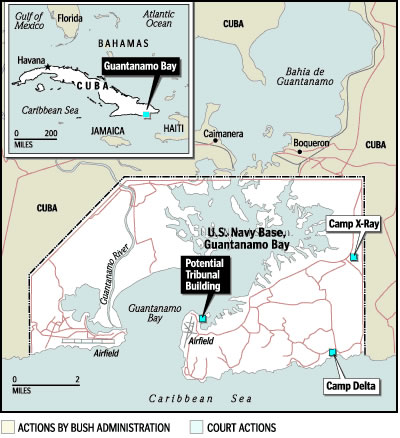
When you get to Guantánamo Bay you won’t have much time before your first appointments with detainees. I have been asked to give you a quick history lesson of the base.
After the U.S. victory in the Spanish-American War in 1898, the U.S. signed the Cuban-American Treaty the following year, which granted a perpetual lease to land for a naval base on the southeast coast of the island. For a brief history with bibliography on the Spanish-American War, see http://www.answers.com/topic/spanish-american-war.
Check the link to the Platt Amendment, which specified the terms of the lease of Guantánamo Bay and granted the U.S. the right to intervene in Cuba to guarantee order and protect U.S. interests.
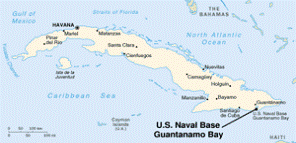
For the past century, the naval base at Guantánamo Bay has been used primarily to service U.S. vessels in the Caribbean and as a weather station. The U.S. treasury department cuts a check each year for the lease, reputed to be only $2000, but the Cuban government refuses to cash the checks.
The transition from naval base to secret prison took place within months following Al Qaeda’s attack on 9/11. The Bush administration had drummed the Taliban from power in Afghanistan and scattered Al Qaeda fighters throughout the region. Many of them, including Osama bin Laden, escaped into the mountainous border region of Pakistan, where he is still believed to be hiding. After initial capture and interrogation at makeshift military camps in Afghanistan or on naval vessels in the Persian Gulf, several hundred “high value” prisoners were taken to Guantánamo Bay beginning in 2002. Others were captured by the C.I.A. in Europe and other locations and taken to secret prisons in Eastern Europe and Middle East. Many of these detainees were taken with complicity of European intelligence and police agencies in defiance of national and international law. These “extraordinary renditions” of terrorist suspects involved unregistered flights by charter companies on C.I.A. contract.
I know that you have been briefed by the Center before your trip and that you have prepared by reading as much has possible. Please keep in mind that the U.S. government wants to close this facility and to begin repairing its relations with allies who have been highly critical of Guantánamo Bay, Abu Ghraib, and other detention centers that were organized with the Bush administration’s War on Terror.
Before we leave the briefing room, I’d like you to watch the following video on former and current detainees; then you need to travel to Gitmo for a brief tour of the camp before your first direct interview with Detainee 997, Dr. Mafoud al-Shabani. He was brought here a year ago from Abu Ghraib. He’s a valuable witness because he was in both facilities after spending several months in a secret Egyptian detention center.
Video: Sudanese detainee 940, Adel Hamad “Guantanamo Waiting for Justice” (You Tube)
http://www.youtube.com/watch?v=qKhWShfhyyg
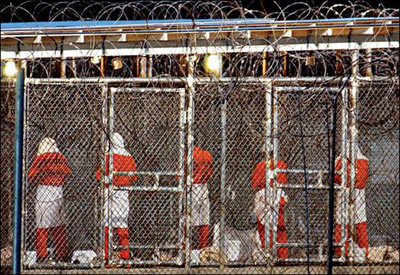
Detainees at Camp Delta, Guantánamo Bay, facing Mecca during prayers
I think you will also be interested in this speech by former detainee, Moazzam Begg, just after his release: http://www.cageprisoners.com/learn-more/legal-issues/item/130-is-torture-ever-justified?
Additional Internet Resources on Guantánamo Bay:
Several books, articles, web links, and documentaries provide reasonably accurate assessments of the plight of detainees at the Guantánamo Bay Naval facility in Cuba.
Wikipedia articles and links on Guantánamo Bay will provide helpful context to the history of the base and its transition to a detention center for high value terrorist suspects (http://www.answers.com/topic/guantanamo-bay-detention-camp). More important is the 54-page report from the United Nations Commission on Human Rights (Feb. 2006), which raises numerous concerns over the treatment of prisoners and violation of their human rights. The article addresses the concerns on the treatment of detainees but also the apparent disregard of international law and multi-lateral treaties by the U.S. government with respect human rights. For the full text of the report, go to the following link: http://news.bbc.co.uk/2/shared/bsp/hi/pdfs/16_02_06_un_guantanamo.pdf.
For an interesting look into the C.I.A. use of charter companies for transporting terror suspects, you may want to begin by looking at a New York Times article from May 31, 2005, on a North Carolina based company, Aero Contractors, Ltd., http://www.mindfully.org/Reform/2005/CIA-Aero-Terror-Flights31may05.htm.
Portions of the Times article come directly from an article six months earlier in the Telegraph, one of the U.K.’s leading newspapers (June 1, 2005).
We encourage trainees to examine important U.S. government websites, especially the Pentagon (http://www.defenselink.mil/), C.I.A. (https://www.cia.gov/index.html) and the Department of State (http://www.state.gov/) to understand official U.S. government positions on extraordinary renditions and international law. However, it is necessary that you look carefully at alternative perspectives from human rights agencies such as Amnesty International, international news sources, and NGOs. David Walsh’s June 1, 2007 article on the World Socialist Web Site provides in depth analysis of the current ACLU lawsuit against Boeing for its complicity in human rights abuses (http://www.wsws.org/articles/2007/jun2007/rend-j01.shtml).
The suit accuses the company of providing flight services through its subsidiary, Jeppesen Dataplan, in the kidnapping and torture of British resident Binyam Mohamed, Italian citizen Abou Elkassim Britel, and Egyptian Ahmed Agiza. Britel had been visiting Pakistan to translate Islamic texts into Italian when he was arrested, beaten, and tortured. He was transferred by the C.I.A. to a prison in Morocco, where he remains. Mohamed continues to be held at Guantánamo; Agiza is in an Egyptian prison and in poor health after severe torture.
A second analytical piece on the Socialist website examines the efforts of Amnesty International to document European government complicity in the secret rendition program (http://www.wsws.org/articles/2006/apr2006/cia2-a29.shtml). For more thorough coverage of Amnesty International documentation and monitoring of secret detention facilities and C.I.A. charter flights, begin with the organization’s press release on February 5, 2007, http://www.wsws.org/articles/2006/apr2006/cia2-a29.shtml, and links to dozens of additional reports.
There are also dozens of wire service stories on C.I.A. kidnappings and charter flights to secret prisons (extraordinary renditions). The BBC reports are brief and highly accurate.
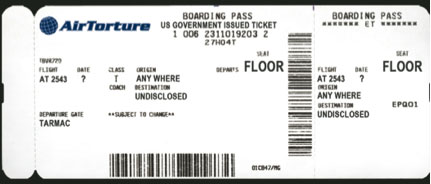
Abu Ghraib Prison, Baghdad
It is difficult to calculate the damage caused by the Abu Ghraib prisoner abuse scandal on the credibility and moral authority of the United States and the Bush Administration. More than any other single event, the publication of photographs of the abuse undermined the administration’s justification for the invasion of Iraq, even more than the failure of U.N. inspectors to find weapons of mass destruction. Clearly Saddam Hussein, the tyrant who built the prison at Abu Ghraib to punish and torture his enemies, may have been a justifiable target for “regime change.” Documentary evidence of his barbarity, including acts of genocide against Kurds and Shiites is substantial. An Iraqi court found him guilty of high crimes and executed him in 2006. But a review of the photographs of the abuse, trial testimony, and media coverage around the world had a staggering negative impact on the administration’s War of Terror and made us a pariah on the international stage.
Photo Gallery: America’s finest defending human rights at Abu Ghraib
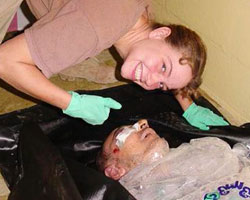 |
| This is the default caption. |
News coverage is also extensive. See an interview with former interrogator Tony Lagouranis: http://www.youtube.com/watch?v=7_VTvUqb3bo. You’ll find at least 20 other YouTube videos that deal with Abu Ghraib. A British news TV report contains testimony from victims of Abu Ghraib and with lawyers who have joined suits against U.S. contractors hired by the C.I.A. to conduct secret detentions, extraordinary renditions, interrogations, and torture. The report deals also with allegations of abuse at Camp Delta, the U.S. military prison at Guantánamo Bay (http://www.youtube.com/watch?v=wF3j4j8H1hk&mode=related&search=). You can see more detailed footage on Guantánamo Bay from the Peter Marshall’s BBC broadcast:
http://news.bbc.co.uk/2/hi/programmes/newsnight/archive/2524241.stm
To listen to a U.S. military contractor Eric Fair express regrets for his actions and describe interrogation techniques used at Abu Ghraib, click on the following interview on National Public Radio (June 7, 2007):
http://www.npr.org/templates/story/story.php?storyId=10806802
You may also read Eric Fair’s February Op-Ed piece, “An Iraq Interrogator’s Nightmare” in the Washington Post (February 9, 2007), free through Lexis-Nexis in the UNCG library’s databases (http://library.uncg.edu/dbs/).
As always, and perhaps more so than with any of your other expeditions, you are encouraged to look for additional sources; however you must be able to justify your choices and vouch for their reputability.