
Pertinent articles of the Universal Declaration of Human Rights:
- Article 1: All human beings are born free and equal in dignity and rights. They are endowed with reason and conscience and should act towards one another in a spirit of brotherhood.
- Article 17: Everyone has the right to own property alone as well as in association with others. No one shall be arbitrarily deprived of his property.
- Article 22: Everyone, as a member of society, has the right to social security and is entitled to realization, through national effort and international co-operation and in accordance with the organization and resources of each State, of the economic, social and cultural rights indispensable for his dignity and the free development of his personality.
- Article 25: Everyone has the right to a standard of living adequate for the health and well-being of himself and of his family, including food, clothing, housing and medical care and necessary social services, and the right to security in the event of unemployment, sickness, disability, widowhood, old age or other lack of livelihood in circumstances beyond his control.
You may have to suspend some prejudices. You’re gonna hear some angry people while you’re here, but you’re also gonna see some folks who are grateful to have you with us.
Before you examine the training resources, I’ve put together some more info. I warn you some of it is dark and some of it funny. I like to include the funny too. New Orleans residents are positive by nature. We try to be positive but the government’s response to the disaster makes us cynical about politics.
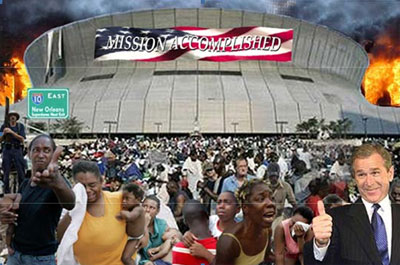
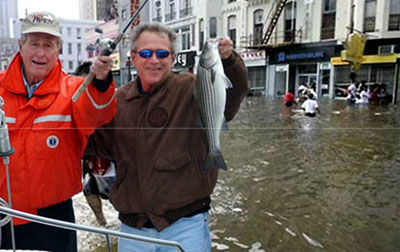
Photos courtesy of About.com: political humor
Global opinion of the Bush II presidency plummeted following the U.S. invasion of Iraq in 2002. Domestic poll numbers were more forgiving about Iraq, at least until the failure to find weapons of mass destruction, which undercut the administration’s justification for the invasion. Approval rates steadily declined over the course of the war, in part due to increasing sectarian violence in Iraq. The rising insurgency brought an increase not only in U.S. casualties but also in the deaths of thousands of innocent Iraqis.
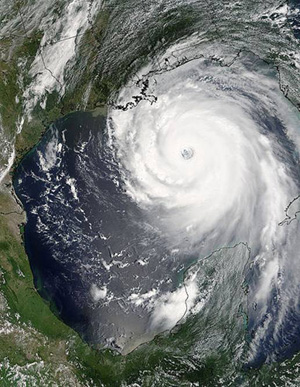
But perhaps the most damaging domestic issue was the devastation caused by Hurricane Katrina and the failure of the U.S. government to respond effectively to the catastrophe. Over 1,800 people died in New Orleans and along the Gulf Coast, and the disaster relief debacle pushed Bush’s domestic poll numbers to approval rates below 30%.
When New Orleans mayor Ray Nagin ordered residents to evacuate on August 28, 2005, Bush was on extended vacation at his Texas ranch. When the levees broke the following day, flooding major portions of New Orleans and displacing several hundred thousand people, Bush declared a disaster. Rather than rush to the scene, as Lyndon Johnson did after Hurricane Betsy in 1969, Bush ordered Air Force One to fly over New Orleans and the Mississippi Gulf Coast a few days later on his return to Washington. Finally, on September 2, the President arrived in New Orleans, along with thousands of National Guard troops, not so much as to provide relief but to prevent looting of food stores and other businesses abandoned during the evacuation.
Breakdowns in communication and distribution networks frustrated relief and reconstruction efforts. Local and state governments were quick to blame the federal government, particularly the Federal Emergency Management Agency (FEMA), managed at that time by horse trader and Republican fundraiser Michael D. Brown. The Feds, in turn, were quick to blame Louisiana Governor Kathleen Blanco and Mayor Nagin. Despite much finger pointing, the real losers were the victims themselves, and the Bush administration’s ineffectiveness in coordinating relief efforts will be the most memorable feature of his domestic policy.
Critics have pointed out that many of the no-bid contracts awarded for hurricane reconstruction went to Halliburton--which Cheney ran as CEO before being elected Vice President--and its subsidiary, Kellogg Brown and Root. Other no-bid contract winners included the Fluor Corporation, the Shaw Group, Bechtel Corporation, and CH2M Hill, all of whom were heavy contributors to political campaigns.
After much public debate over government ineffectiveness, broken promises, and the stench of cronyism, the administration and all agencies involved in Katrina relief
have not shaken the blistering accusation that racism was the chief factor in the failure to meet the most basic needs for shelter, food, healthcare, and economic assistance. The inability for the U.S. government to respond effectively to Katrina prompted offers from Venezuela to provide gasoline and Cuba to send 300 doctors for the relief effort.
The most blistering criticism of government incompetence and indifference has come from the black community. Michael Eric Dyson, in his angry book of essays, Come Hell or High Water: Hurricane Katrina and the Color of Disaster (New York: Basic Books Civitas, 2006), blasts the Bush administration for its unabashed commitment to the wealthy and business elites and neglect to those who were too poor to evacuate the floodwaters. His central analysis is that to be black and poor is to be left behind in American society. What’s at stake for Dyson is that Katrina was much more than a failure of the Corps of Engineer levee system or FEMA’s ineptitude. The real failure was that a supposedly democratic government spends so much energy preserving its guiding fictions of liberty, equality, and justice that it was blind to the reality of its own incompetence, injustice, and indifference.
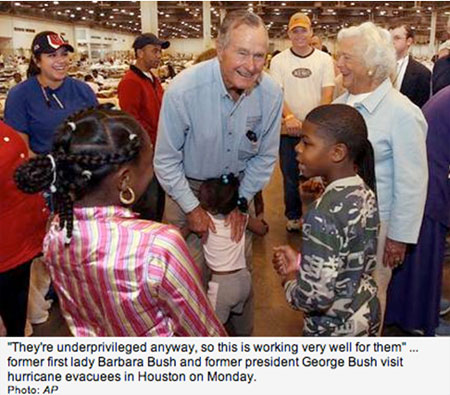
Perhaps the most telling aspect of class indifference came when Barbara Bush, the President’s mother, made the following comment about the thousands of dispossessed New Orleans evacuees who found shelter in Houston’s Astrodome:
An even more cynical comment came from GOP Congressman Richard H. Baker of Baton Rouge, who told a group of lobbyists, “We finally cleaned up public housing in New Orleans. We couldn’t do it, but God did” (http://www.washingtonpost.com/wp-dyn/content/article/2005/09/09/AR2005090901930.html).
Please get familiar with the following resources.
1. General Internet Sites:
NOAA's weather site on Katrina: http://www.katrina.noaa.gov/
“Silence is Violence,” anti-crime site maintained by New Orleans residents,
http://silenceisviolence.org/."Voices from the Gulf"
“Color of Change,” advocacy website that monitors Katrina recovery, racism, and poverty (http://www.ColorOfChange.org). See also the New Orleans Time-Picayune site devoted to Katrina: http://www.nola.com/katrina/
2. Political effects of Katrina
http://en.wikipedia.org/wiki/Political_effects_of_Hurricane_Katrina
http://en.wikipedia.org/wiki/Hurricane_Katrina#Government_response
3. Racism and Katrina
http://www.zmag.org/content/showarticle.cfm?ItemID=8625
http://www.foxnews.com/story/0,2933,177900,00.html “Black Witnesses Testify Racism Influenced Katrina Response”
http://www.foxnews.com/story/0,2933,177765,00.html “FEMA Katrina E-Mails Show Agency in Disarray”
http://www.foxnews.com/story/0,2933,177618,00.html “Documents Show Political Storm in Katrina Aftermath”
4. Books and articles:
Dave Eggers, Zeitoun (New York: Vintage, 2010).
Douglas Brinkley, The Great Deluge: Hurricane Katrina, New Orleans, and the Mississippi Gulf Coast, New York: Harper Collins, 2007.
John McQuaid and Mark Schleifstein, Path of Destruction: The Devastation of New Orleans and the Coming Age of Superstorms, New York: Little, Brown and Company, 2006. See also McQuaid’s op-ed piece in the Washington Post, “The Can’t Do Nation,” August 5, 2007.
Chris Mooney, Storm World: Hurricanes, Politics, and The Battle over Global Warming,
New York: Harcourt, 2007. See review article by John McQuaid, Sunday, July 29, 2007; p. BW07, Washington PostU.S. Government 2005 “Complete Guide to the Hurricane Katrina Disaster” on CD-ROM (available at Amazon.com)
5. Documentaries, Films, and Videos:
www.youtube.com contains thousands of videos from New Orleans and the Gulf Coast. For the purposes of this course, see “Two years after Katrina and thousands still w/o homes” http://www.youtube.com/watch?v=95XH7pTPg2U, and “Forgotten Communities, Unmet Promises,” http://www.youtube.com/watch?v=LtRWOjh1XF8.
“New Orleans Residents Rescue Their Neighbors in Absence of Government Response,” September 6, 2005 report by Democracy Now! Producer John Hamilton. See full transcrip and real player video stream: http://www.democracynow.org/2005/9/6/new_orleans_residents_rescue_their_neighbors
“The Storm” (PBS Frontline documentary), November 2005. http://www.pbs.org/wgbh/pages/frontline/storm/
Tavis Smiley, “The Right to Return: New Orleans Home Movies from the Lower Ninth War,” May 16, 2007: http://www.pbs.org/wnet/tavissmiley/features/right-to-return/
“New Orleans: Music in Exile,” Dir. Robert Mugge, 110 min.
“Kamp Katrina,” Dir. Ashley Sabin and David Redmon, 75 min.
“When the Levees Broke,” narrated by Spike Lee, 4 hours, 3-Disc series, 2006
“National Geographic: Inside Hurricane Katrina,” 2005
“Hurricane Katrina: The Storm that Drowned a City,” PBS Nova Series, 55 min., 2005
“Routes to Recovery,” American Public Media, radio documentary, Aug. 25, 2007, 60 min., http://americanradioworks.publicradio.org/features/nola/index.html. See Links to videos and other resources.
One of our course participants also recommends the videos on youtube listed under "fluxrostrum Katrina."